

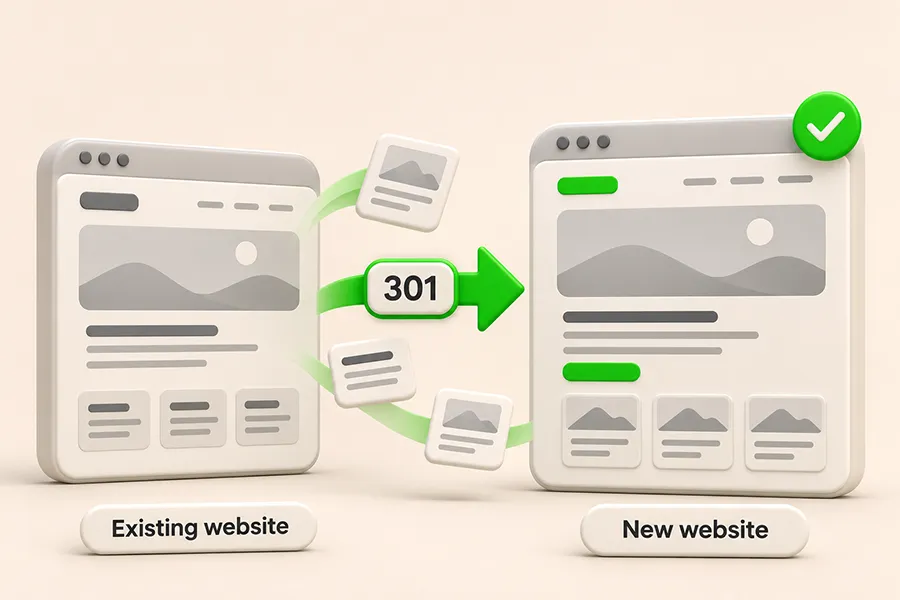
A redesign does not have to mean losing your existing search traffic. Protecting the visibility you have already earned is a priority throughout our redesign process.
We review your existing website before making changes, identify what is working and plan how it will carry across to the new website. Where page addresses change, we put permanent redirects in place and test them before launch.
Search rankings can fluctuate while Google processes significant changes. Careful preparation reduces avoidable risks, but no agency can guarantee that every ranking or traffic level will remain unchanged.
Protect what is already working
Your existing website gives us an important starting point.
Some pages may already attract relevant searches, generate enquiries or have valuable links pointing to them from other websites. We need to understand that before deciding what to change.
We review the available search and analytics information alongside your content and website structure. This helps us identify pages that deserve particular care during the redesign.
Map existing pages to the new website
We create a page-mapping spreadsheet to record what happens to your existing content.
Your current sitemap is a starting point. We also check the website itself and available search data, because a sitemap may not contain every address that visitors or search engines still use.
The mapping records whether each page will stay at its current address, move, merge with another page or be removed.
| What happens to the page? | Our approach |
|---|---|
| It stays at the same address | Retain the URL and review the content and SEO elements |
| Its address changes | Redirect the old address to its new equivalent |
| Several pages are combined | Review their value and map them to the relevant combined page |
| It is no longer needed | Check for a suitable replacement; where none exists, return an appropriate page-not-found response |
There is no need to change a useful page address simply because we are redesigning the website.
Redirect changed page addresses
When a page moves, a 301 redirect sends visitors and search engines from its old address to its new one.
In everyday language, it says: “This page has moved permanently. Here is where you can find it now.”
That helps people arriving through an existing Google result, saved bookmark or link on another website reach the appropriate page.
The destination matters. We match moved pages to relevant replacements rather than sending everything to the homepage. Google’s migration guidance supports this approach.
On our Apache-hosted websites, these instructions can be managed through a server configuration file called .htaccess. You do not need to handle that code yourself: we prepare and test it as part of the agreed migration work.
We also aim to redirect directly to the final destination, avoiding unnecessary chains of redirects. Redirects are a continuing part of the migration, rather than something to remove immediately after launch.
Read Google's website migration guidance (opens in a new tab)
Preserve more than page addresses
Redirects are important, but they are only part of protecting existing search visibility.
Keeping an address unchanged will not preserve everything if the useful content disappears or the page starts answering a different question.
We also review:
- Page titles, main headings and important content.
- Internal links and navigation.
- Images, downloads and other useful resources.
- Canonical addresses and indexing settings.
- The new XML sitemap.
We have seen the consequences when this planning is missed. In one engineering website we were asked to help with, a previous redesign had changed page addresses without putting the necessary redirects in place. Search traffic had fallen substantially, and investigating the missing redirects became part of the recovery work.
It is the kind of avoidable problem we want to identify before launch.
Test before the new website goes live
A mapping spreadsheet records the plan. Testing checks that the finished website follows it.
Before launch, we check that important pages are available, changed addresses reach the intended destinations and internal links use the correct URLs. We also check that development restrictions have been removed so the public website can be indexed.
We test the agreed analytics and enquiry tracking too. Otherwise, a measurement problem could make a successful launch look like a traffic loss.
Monitor what happens after launch
The work continues after the new website is published.
We use the available reporting to check search visibility, visits, indexing and enquiries, and investigate unexpected changes.
Google advises that rankings may fluctuate while it recrawls and reindexes a changed website. The time involved varies, so we do not promise that any dip will be slight or recover within a fixed period.
We have seen temporary dips settle after launches, but monitoring helps us distinguish normal processing from an issue that needs attention.
Build on the foundations
Protecting existing performance is the starting point. The redesign should also give your business a better website to build on.
That may mean clearer service information, better navigation, faster pages and a more useful route towards enquiry.
Google’s ranking systems take Core Web Vitals into account, but better performance scores alone do not guarantee higher positions. Speed supports the wider work on content, relevance and customer experience.
Read Google's explanation of Core Web Vitals (opens in a new tab)
If you are still considering the right approach, read our answer to does our website need a redesign, or could we improve what we have?.