

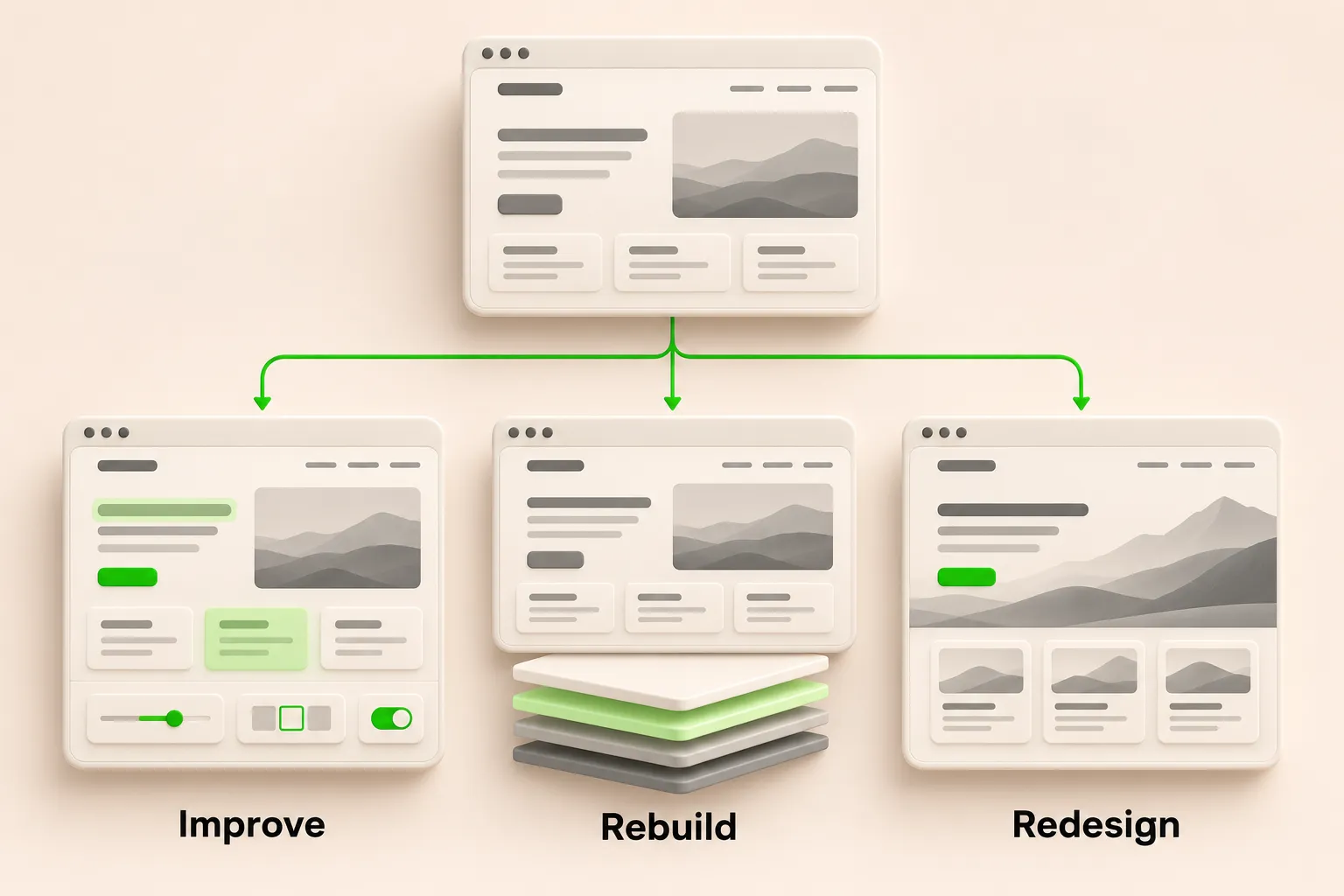
You may not need to start again. If your website looks right, explains your business clearly and brings worthwhile enquiries, targeted improvements could be the sensible choice.
But appearance is only part of the decision. A website can look perfectly respectable while being slow, difficult to navigate or increasingly awkward to maintain.
I look at three possibilities: improve the website you have, rebuild it using a better technical foundation, or redesign it around what your business needs now.
Improve, rebuild or redesign?
These are different jobs, although they can overlap.
| Approach | What changes | When it may make sense |
|---|---|---|
| Improve | Selected content, layouts, navigation or technical issues | The existing website provides a sound foundation |
| Rebuild | The underlying website system, retaining the design where appropriate | You like the appearance, but performance or maintenance is holding you back |
| Redesign | Design, structure and content, alongside the build | The website no longer represents your business or supports your buyers effectively |
When improvements are enough
Sometimes the main weaknesses are concentrated in a few places.
Your service pages might need clearer explanations. Important information may be difficult to find. The contact form might ask too much, or visitors may struggle to understand what happens after they enquire.
We review the pages, the available performance information and the route towards enquiry. If the existing website can support the improvements your business needs, we explain what we would change and what we would keep.
The same applies to the design. You do not need a new visual identity simply because someone thinks your website should look more fashionable. If you and your customers are happy with it, we need a practical reason to change it.
When a rebuild could help
You might like the appearance of your website but be frustrated by how it works. Perhaps pages load slowly, maintenance has become complicated, or the website has accumulated features your business barely uses.
WordPress is an established platform. It can support excellent websites, including fast ones. We welcome WordPress conversions, but we assess the particular website rather than assuming its platform is the problem.
The way a website has been assembled matters. Page builders make it easy to drag elements into place, adjust spacing and add effects. That convenience can also introduce additional code and scripts. As features accumulate, visitors’ devices may have to download and process much more than the content itself requires.
WordPress usually assembles pages using information held in a database, although caching can allow prepared copies to be served quickly. A database is not automatically a performance problem, and a long source-code listing alone does not tell us whether a website is slow.
What matters is what visitors experience and what is responsible for any delay.
Our lightweight build approach prepares the main pages in advance, reducing the work needed to deliver them to the browser. We optimise images and limit unnecessary scripts, while agreeing the forms, editing features and integrations your business needs.
When a redesign makes more sense
A redesign becomes more useful when the problems go beyond the underlying technology.
Your business may have developed while the website has stood still. New services might have been squeezed into an unsuitable menu. Your best work may be difficult to find, or the content might describe what you do without explaining why a buyer should choose you.
These are questions of structure, communication and customer experience.
We look at what prospective customers need to understand, the evidence that will give them confidence and the next steps available to them. That informs the page structure, navigation, content and design.
There is still room for personality. Some businesses suit a bold visual style; others need a quieter approach. Personally, I favour subtle movement: content appearing as it enters view and small cues that draw attention to a section someone has selected. You can see that approach on this website.
Why speed matters
A website should make it easy to reach information without unnecessary waiting. That matters whether someone is researching a supplier at their desk or checking your services on a phone between appointments.
We build with performance in mind from the start: preparing images carefully, keeping pages lightweight and checking the effect of additional features.
Tools such as Google Lighthouse help us assess performance and identify improvements. We aim for excellent results, but a score is a test result under particular conditions. Devices, network connections, third-party tools and consent choices can affect it.
We also review the foundations that help people and search engines understand your pages, including titles, headings, URLs, internal links and indexing settings. Those checks belong in the build process, rather than being left until after launch.
Look at the journey towards enquiry
A quick website still needs to help people make decisions.
Can visitors recognise that you provide what they need? Can they find the relevant service, assess your experience and understand how to take the next step?
Where suitable data is available, our visitor journey system helps us visualise the routes people take through the website. Its Sankey charts show how recorded visits flow between pages, where visitors continue and where their recorded journeys end.
Combined with search information, campaign results and feedback from your sales team, these patterns help us choose improvements worth testing. We might find that a frequently visited page offers no useful onward route, or that visitors repeatedly look for information which should have been clearer earlier.
Our visual sitemap also helps us review the overall structure: which pages exist, how they fit together and where useful content is missing. Together, the planned structure and recorded journeys give us a clearer basis for improving the website.
How we recommend the right approach
We start by understanding your business and reviewing what you already have.
Our Opportunity Investigation considers your buyers, priorities, existing content and available evidence. We identify what is working, where the website may be holding you back and which changes deserve attention.
From there, we explain whether we recommend improvements, a rebuild or a redesign, together with the scope and cost.
If we recommend a rebuild or redesign, protecting valuable existing content and search visibility forms part of the planning. We agree what will be retained, what will change and how the launch will be handled.