

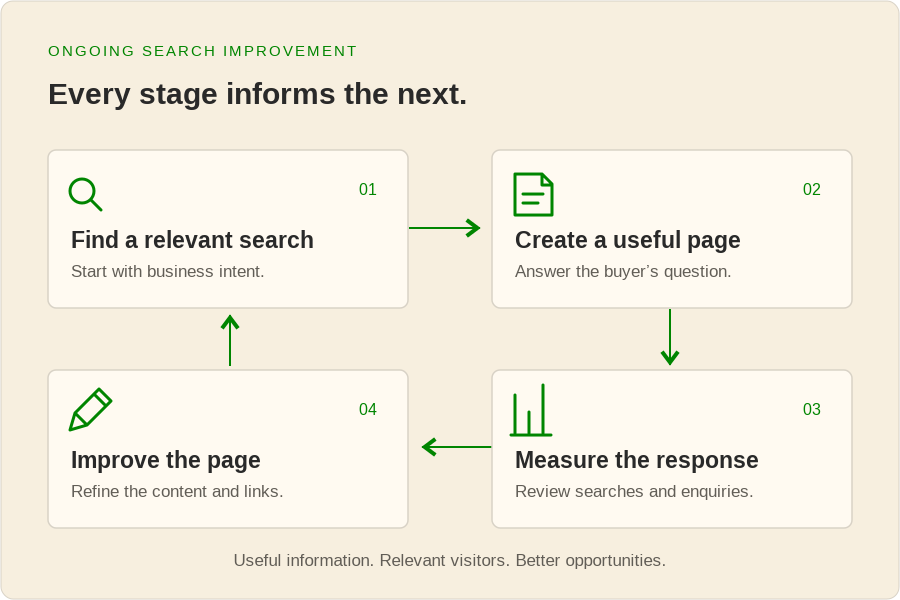
We improve your chances of appearing for searches made by potential customers, then help those visitors find the information they need to enquire. We research the opportunity, create useful pages and refine them using evidence from Google Search Console, website activity and your feedback.
The aim is to earn better positions for searches that matter to your business. A phrase attracting hundreds of visitors is less valuable than it looks if none of those people needs what you offer.
Start with the searches your customers make
We begin with your business: what you sell, who buys it and what those buyers need to understand before contacting you.
Google Keyword Planner helps us explore search language and estimate demand. We assess intent alongside the numbers. Is someone learning about a problem, comparing options or looking for a supplier? Can your business help them take the next step?
Those decisions guide which existing pages we improve and what new content is worth creating.
Create something worth finding
A page needs to answer the question behind the search. That might mean explaining a process, comparing solutions or showing how your service meets a particular requirement.
We use your expertise, examples and product information to make the content useful and specific. Clear headings help people find the detail they need, while relevant links connect the answer to supporting information and your services.
The search phrase gives us a starting point. The reader’s needs guide what goes on the page.
Learn which searches the page actually appears for
Once Google starts showing the page, Search Console helps us see which queries it appears for, how often it records an impression and whether people click through.
This can reveal useful variations we did not anticipate. We assess whether those searches fit your offer and whether the page provides the answer someone would expect.
Impressions measure your visibility, rather than the total number of searches for a phrase. We use them alongside clicks, average position and estimated demand to identify opportunities worth investigating.
What do impressions and average position mean?
An impression records an appearance under Google's counting rules. With ordinary paginated results, your listing can count when it is on a results page someone opens, even if they do not scroll that particular listing into view. A result on page ten does not automatically receive an impression whenever somebody searches. Other result formats have different visibility rules.
Average position summarises recorded appearances. It is not a fixed ranking or a precise page number. We review trends across relevant searches and meaningful periods.
Read Google's explanation of impressions and position (opens in a new tab)
Revisit the page and make its purpose clearer
As relevant queries emerge, we return to the page. We check its SEO structure and improve the answer around the opportunities that fit your business.
| Part of the page | What we improve |
|---|---|
| SEO title | Clearly describe the subject using the main relevant search theme. |
| Headings | Make the topic clear and organise the questions the reader needs answered. |
| Opening paragraph | Quickly confirm what the page covers and who it helps. |
| Main content | Fill useful gaps, clarify explanations and add examples or evidence. |
| URL | Use a clear address for new pages; retain established URLs unless there is a good reason to change them. |
| Internal links | Connect relevant explanations, supporting pages and useful next steps. |
We use search terms naturally where they clarify the subject. A different question may need a new section or a separate page, rather than squeezing another phrase into an existing heading.
We also check that technical problems are not preventing Google from finding and indexing the page.
An example: competitor audience targeting
Our page about competitor audience targeting provides an example of how we would apply this process. The following is illustrative, rather than a report of its current rankings or results.
Suppose Search Console showed that page appearing for a relevant question about reaching competitors’ audiences through Google Ads. We would check what the person is trying to achieve and whether the page explains the available options and their limitations clearly.
If that question fits the page’s purpose, we could refine the title, heading and introduction, improve the explanation and make the route to our Google Ads management service clearer.
We would also look for related paragraphs elsewhere on our website where a link to that explanation would help the reader. We would then monitor subsequent visibility, clicks and enquiries to assess the response.
Use enquiry evidence to choose where to invest
SEO takes time and sustained work. Where appropriate, a focused Google Ads campaign can help us test which searches lead to useful actions before investing more heavily in a subject.
With conversion tracking and your feedback, we can distinguish enquiries that fit your business from those that do not. That evidence helps us prioritise the subjects most likely to support your goals.
Advertising is optional and agreed separately. It can inform SEO decisions; it does not buy better organic positions or guarantee that organic visitors will respond in the same way.
Connect the right paragraphs to the right pages
Our own contextual link analysis system helps us examine your pages and their paragraphs to identify related information and suggest useful links.
We review each recommendation in context. Does the destination help answer the question being discussed? Is this a sensible point to offer it? Does the link text explain what the reader will find?
These links give visitors clearer routes through your website and help Google discover pages and understand how they relate. Google explains this in its guidance on links (opens in a new tab).
Useful content may also earn references from other websites. These backlinks can support discovery and search visibility. We focus on giving people a reason to reference your work, rather than buying links to influence rankings.
Keep improving towards better business opportunities
Search Console shows us what happens in Google Search. Website activity, recorded visitor journeys and feedback about enquiries help us understand what happens afterwards, within the data available.
We use that combined evidence to decide what deserves more attention: a stronger explanation, clearer headings, a useful supporting article or a better route towards contacting you.
Results take time and positions are not guaranteed. Our job is to make purposeful improvements, review the response and direct the next round of work towards the opportunities that matter to your business.
Find a relevant search. Create a useful page. Measure the response. Improve the page. Each stage informs the next.
Explore our website marketing service →