

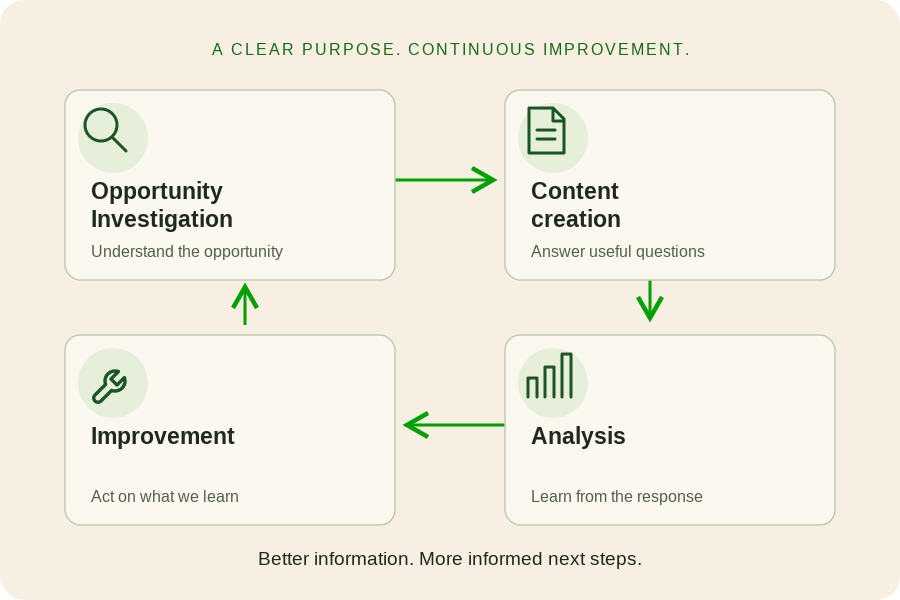
We investigate where the opportunities are, create useful information for your buyers, review the response and improve the website using what we learn. That includes working on your existing pages, as well as deciding what to add next.
The aim is to attract more of the people your business wants to reach and help them move towards a worthwhile enquiry. We agree priorities and delivery capacity with you, so the work has a clear purpose and a practical scope.
The first stage is about understanding your business and establishing the plan. In later months, the balance shifts towards publishing, analysis and improvement. We do not start from scratch every month or publish articles simply to reach a quota.
Understand your goals and investigate the opportunity
We begin with a conversation about your business, customers and commercial goals. Where possible, we involve your sales manager or the people handling enquiries: they know which questions keep coming up and what makes a lead worth pursuing.
We want to understand the services or products you want to grow, who buys them, what problems those buyers need to solve and what has worked for you so far.
Our Opportunity Investigation then brings together your website and marketing data, search-demand research, competitor activity and publicly available information. Keyword Planner can help us explore demand, alongside the search information already available for your website.
Competitor research may include estimated search visibility and traffic, publicly visible pages and available advertising history. These sources have limits: estimates are not access to a competitor’s private analytics, and a long-running advert does not prove that it is profitable.
We also look at relevant discussions on sites such as Reddit and specialist forums. The purpose is to understand the language people use and the problems they describe, rather than copy their conversations or assume a few comments represent the whole market.
Turn the findings into an agreed programme
We prioritise a manageable set of tasks based on the opportunity, your ability to deliver the offer and the work included in your plan.
That might mean improving an existing service page before writing anything new. Or we may need a clearer main topic page and supporting articles to answer the questions buyers ask around it.
You can see the planned structure in a shared visual sitemap. It shows how pages fit together, what has been published and what is waiting next. As evidence develops, we can update the plan rather than treat the original sitemap as fixed.
We agree responsibilities too: what we will research and write, which technical details your team needs to check and which decisions require approval.
Create useful content around your buyers’ questions
Where it suits the subject, we organise content around a main page supported by more detailed pages. These are often called pillar and cluster pages.
For a company supplying deburring equipment, for example, the main page might explain the options. Supporting articles could help buyers compare methods, consider suitable equipment for different materials or understand what affects the finished result.
Each page needs a useful job. It should answer a real question, help someone assess an option or make the next step clearer. The pages link together where that helps the reader.
We use your experience, product information and practical examples to make the content specific to your business. A cluster structure is useful organisation; it does not automatically establish authority or guarantee rankings.
Analyse the response and improve existing pages
We review the information available through Google Search Console, analytics and any agreed advertising activity. Different sources answer different questions: search impressions can reveal relevant queries, while website activity and sales feedback help us assess what happens afterwards.
We look for evidence about which topics attract relevant interest, what visitors appear to need and where the route towards enquiry could be clearer.
| What we learn | What we may do next |
|---|---|
| A page appears for a relevant search but does not answer it clearly | Improve the explanation, title or headings |
| Visitors need detail missing from the main page | Add a useful section or supporting article |
| A service page attracts interest but few recorded next steps | Review the offer, reassurance, links and contact options |
| Existing articles cover related questions | Strengthen useful links between them |
| Content attracts enquiries outside your target market | Clarify who the service is for and review the topic’s relevance |
We may adjust titles, headings, copy, images, supporting evidence and internal links. These are considered changes based on the page’s purpose, rather than adding every search phrase that appears in a report.
Some content produces a strong response; some does not. A quieter page may still reveal useful queries, but low activity is not automatically useful evidence. We consider how long it has been live, whether it can be found, the size of the audience and the information actually available before deciding what to change.
Help people take the next step
Not everyone arriving from search is ready to contact a supplier. Some are learning about a problem, some are comparing solutions and others are ready to request a quotation.
We try to provide the appropriate information and onward route for each stage. That can mean linking an explanatory article to a comparison, a comparison to a relevant service and the service to a clear enquiry option.
Our Webstudio visitor journey system helps us examine recorded paths between pages. Its Sankey charts highlight commonly recorded routes and places worth investigating. We originally developed it to help us assess navigation and whether visitors could reach useful information at the right point.
It cannot tell us a visitor’s motivation on its own, and it only shows activity the tracking records. We use it alongside search information and your team’s feedback, rather than treating a chart as a complete account of every visit.
Make useful content work through email too
Where email marketing is included in the agreed programme, we prepare suitable articles so they can also be shared through newsletters. That can use our newsletter system or an existing platform such as HubSpot, subject to the required setup and access.
If you already have a suitable mailing list, we can plan content for it. If you do not, we can help create reasons for interested people to subscribe and consider a useful information exchange: something worth receiving in return for providing their details.
That could be a practical guide, checklist, comparison tool or another resource that fits the buyer’s problem. It does not have to be a PDF.
We may initially make resources freely available and review the response. Where a topic demonstrates interest, we can develop a more substantial resource and test whether people value it enough to request it. Popularity alone does not prove that adding a form will improve results, so we assess the effect.
We make the exchange clear, collect only the details needed and distinguish requesting a resource from choosing to receive future marketing. An email address is the start of a possible relationship, rather than proof of a qualified sales opportunity.
Keep you informed every week
We agree the measures that matter to your business and set up automated reporting for Monday mornings. Depending on the agreed setup, that can include charts, tables and a concise view of relevant traffic, search visibility and important website actions.
In Google Analytics, useful actions can be recorded as key events. These might include a confirmed enquiry submission, quotation request or relevant resource download. We distinguish those actions from lighter signals such as clicking a button.
Read Google's explanation of key events (opens in a new tab)
Reports depend on the available data, tracking setup and visitors’ consent choices. A recorded download is not the same as an enquiry, and an enquiry is not the same as a sale. Your team’s feedback helps us judge quality.
Weekly figures can be uneven, particularly for businesses with smaller audiences or longer sales cycles. We also review trends over a more meaningful period, rather than react to every short-term change.
What a typical month could include
The exact mix depends on your priorities, the available evidence and the delivery capacity in your plan. A typical month might include:
- Reviewing performance and feedback on enquiries.
- Improving a priority service or topic page.
- Researching, writing and publishing agreed supporting content.
- Checking useful internal links and routes towards enquiry.
- Preparing a newsletter or developing a helpful resource where agreed.
- Updating the shared sitemap and recommending the next priorities.
Paid advertising may form part of the programme where agreed. Its scope, management and advertising spend are made clear separately; the list above does not mean every activity is delivered every month at every service level.
You bring the knowledge of your business and the feedback from sales. We take responsibility for recommending priorities, progressing the agreed work and explaining what we learn.
Each month builds on the last: investigate, create, analyse and improve.