

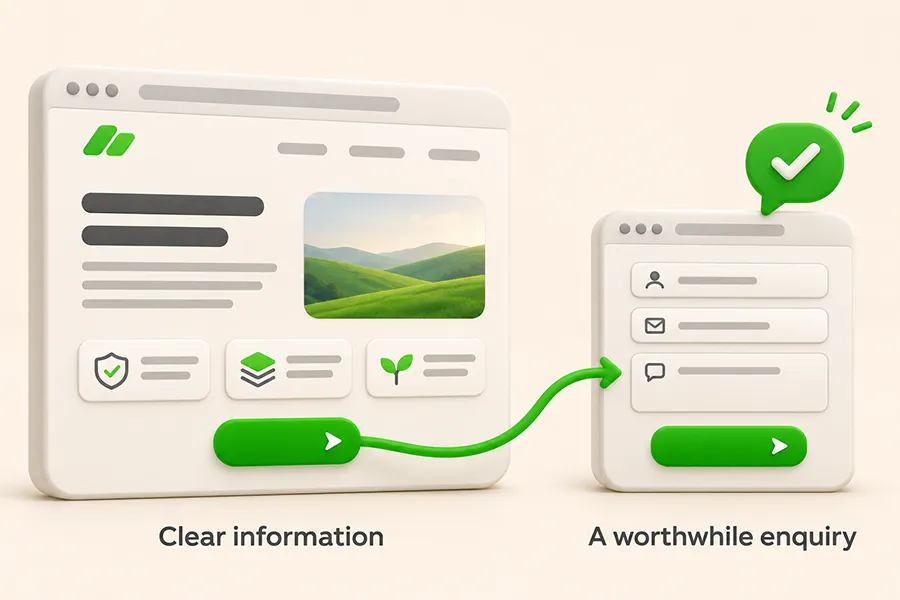
We start with what your business needs the website to achieve. The design then helps visitors understand your offer, see reasons to trust you and find an appropriate next step.
Every website redesign we undertake includes an Opportunity Investigation. That gives us a basis for decisions about the content, navigation and visitor journey before we start arranging pages.
We cannot promise a particular number of enquiries. We can explain how the website is being designed to support them, what we are basing our decisions on and how the agreed tracking will help you assess the result.
Start with the business and the opportunity
Before discussing colours or layouts, we need to understand your business. What do you sell? Who are your best customers? Which enquiries are worth having, and what would you like more of?
A company looking for complex engineering projects needs a different enquiry journey from a business selling a straightforward local service. The information, evidence and next step should reflect that.
Our Opportunity Investigation considers your market, competitors, existing website and available performance information. We look at what other businesses explain, how they present their offer and where your own website could be more useful.
Publicly available competitor information can suggest opportunities. It cannot prove that a competitor’s page or campaign generates profitable business. We separate what we can observe from what we think is worth testing.
Decide what to keep, improve or add
Your existing content is a starting point. Some pages may already bring relevant visitors or help customers make decisions. Others may be outdated, duplicate information or leave important questions unanswered.
We review the available evidence and recommend what to retain, improve, combine or add. That can include comparing your coverage with competitors to identify useful content gaps.
| What we find | What we may recommend |
|---|---|
| A service page attracting relevant visitors | Keep its useful content and improve the route towards enquiry |
| A page that no longer reflects your business | Update it or discuss whether it should be retired |
| Several pages covering the same ground | Review whether combining them would make the information clearer |
| A recurring question with no useful answer | Add a page or section that answers it |
| Strong claims with little supporting evidence | Add relevant examples, testimonials or case studies |
We explain the evidence behind our recommendations and agree changes with you. Where the data is limited, we say so. Low traffic alone does not make a page worthless: it may support an important sales conversation or serve a small but valuable audience.
Cater for different ways of making decisions
Visitors do not all need the same amount or type of information before they contact you.
One planning framework we draw on describes four buying modes: competitive, methodical, humanistic and spontaneous. We use these as prompts for reviewing content, rather than fixed labels for every visitor.
| Buying mode | Questions the website should help answer |
|---|---|
| Competitive | Can you solve my problem? What makes you a strong choice? |
| Methodical | How does it work? What are the details, limitations and supporting facts? |
| Humanistic | Who will I be dealing with? Have you helped people or businesses like mine? |
| Spontaneous | Does this feel right for me? Can I take the next step easily? |
The practical result is a website with a clear summary for someone scanning quickly, useful detail for someone researching carefully, reassurance about the people behind the business and an easy way to get in touch.
Read about the Eisenbergs' buying-mode framework (opens in a new tab)
Make the offer clear and give people confidence
A visitor should be able to understand what you offer, who it is suitable for and why it may be worth considering.
That means explaining benefits alongside capabilities. If a machine produces a particular finish, for example, we should help the buyer understand where that finish is useful and which requirements the machine can meet.
We also look for appropriate reassurance. Marketers call these “trust signals”, but they are simply things that help a visitor judge whether you can deliver: relevant testimonials, genuine accreditations, examples of completed work, customer logos used with permission and clear information about your team.
The evidence should sit where it helps answer a question. A relevant engineering case study beside a service explanation may be more useful than a general collection of logos at the bottom of the homepage.
Give visitors a useful next step
The journey does not always begin on the homepage. Someone may arrive directly on a service page, an article or a campaign landing page.
Each important page should help them understand where they are, find related information and take a sensible next step. That might be an enquiry, a call, a quotation request or further reading.
Someone researching a problem may need an explanation before they are ready to speak to you. Someone comparing suppliers may need specifications or a case study. Someone ready to act should be able to find the contact option without searching through the menu.
We also review practical obstacles: forms that ask for unnecessary information, unclear button labels, difficult mobile layouts and uncertainty about what happens after submitting an enquiry. We test the agreed forms and confirmation messages before launch.
Connect useful pages from the start
We put relevant internal links in place during the redesign, alongside the main navigation. We do not wait for traffic data before connecting pages that clearly belong together.
Where appropriate, we organise content around a main topic page supported by more detailed pages. These are often called pillar and cluster pages.
For an engineering business offering deburring, the main page might explain the service and its applications. Supporting pages could cover different deburring methods, suitable materials, machine choices and examples of finished components. Links help visitors move between the overview and the details they need.
This gives buyers a more useful resource and makes the relationship between your pages clearer. It does not guarantee rankings or authority simply because a particular structure is used.
After launch, search and visitor information can help us refine those links and identify further questions worth answering. A fast, accessible website supports that work, but speed alone does not guarantee that Google will discover or index new pages immediately.
Measure useful activity and learn from enquiries
We agree the tracking needed to assess relevant website activity, subject to visitors’ consent choices and the services included in your project.
A button click and a submitted form tell us different things. Neither, on its own, tells us whether an enquiry was a good fit or became a customer. Feedback from your team helps connect website activity with business value.
Where suitable tracking is available, our visitor journey system can visualise recorded routes between pages. Its Sankey charts help us identify patterns worth investigating, such as a popular service page with little onward activity.
The charts do not tell us why somebody left, and they cannot show activity the tracking did not record. We use them alongside search information and business feedback to choose improvements worth testing.
Agree what happens at launch and afterwards
The redesign establishes the agreed content, structure, enquiry routes and measurement foundations. We may recommend new pages or substantial content improvements; the scope and cost of that work are agreed before we proceed.
If you want to develop the website further, ongoing website marketing can build on those foundations. That may include reviewing search terms, understanding whether people are researching or ready to buy, improving existing pages and creating supporting content.
We do not need to publish blindly and wait for clues. The initial investigation gives us a starting direction; evidence gathered after launch helps us refine it.
You can explore our website marketing service for ongoing support, or talk to us about what you want your website to achieve.